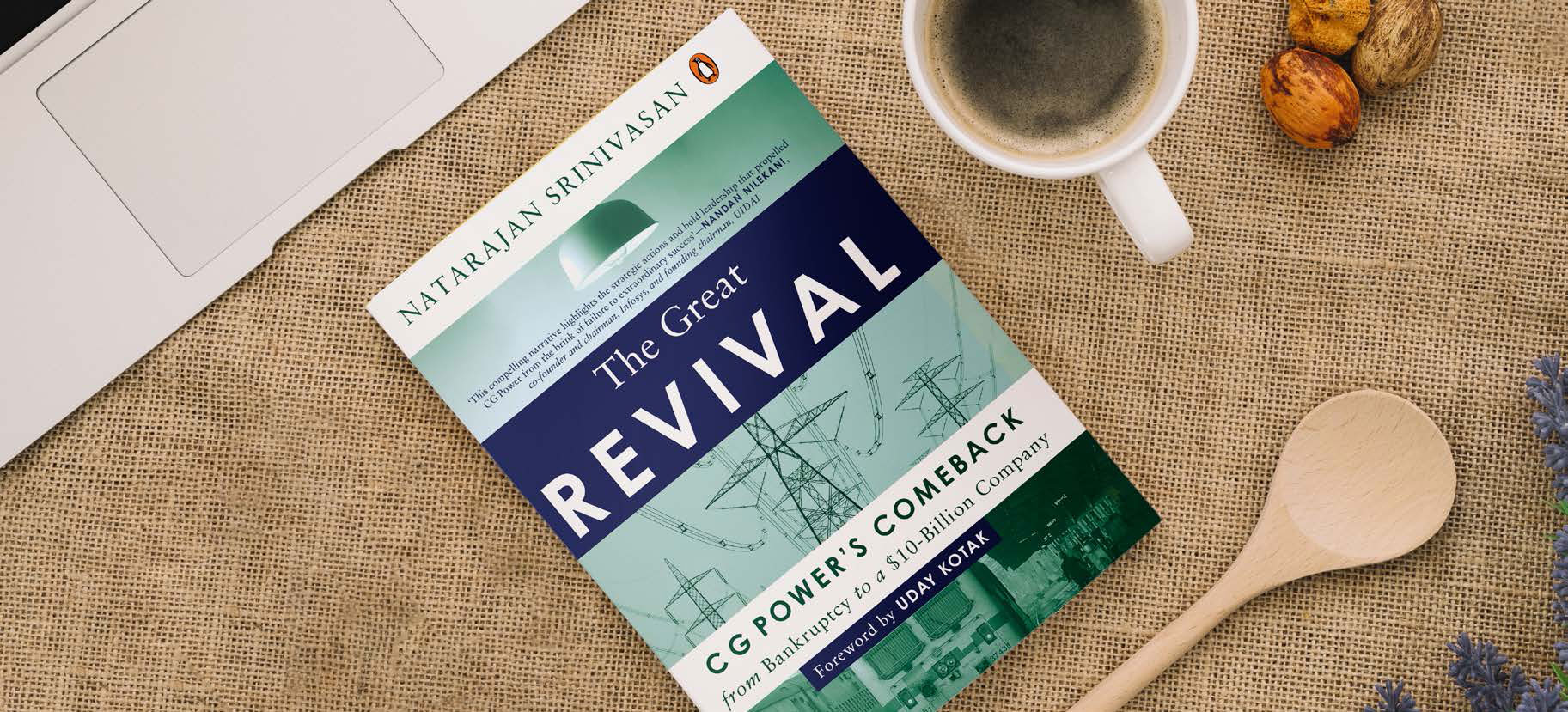
Book synopsis
‘The Great Revival: CG Power’s Comeback Story From Bankruptcy To A $10 bn Company’ is the gripping story of how CG Power and Industrial Solutions Ltd., once an 80-year-old engineering icon, collapsed under the weight of corporate misgovernance — and how it rose again to its former glory and beyond through the interplay of integrity and managerial responsiveness.
In the pre-turnaround phase, the company spiraled into a crisis following a series of unauthorised transactions after its former promoter diverted nearly ₹3,000 crore from the company. This lay undetected for long. Investigations by SEBI, SFIO, and the CBI followed; auditors resigned, accounts were disclaimed, the share price plunged to ₹5, and the business moved towards bankruptcy.
‘The Great Revival: CG Power’s Comeback Story From Bankruptcy To A $10 bn Company’
is the gripping story of how CG Power and Industrial Solutions Ltd., once an 80-year-old engineering icon, collapsed under the weight of corporate misgovernance — and how it rose again to its former glory and beyond through the interplay of integrity and managerial responsiveness.
In the pre-turnaround phase, the company spiraled into a crisis following a series of unauthorised transactions after its former promoter diverted nearly ₹3,000 crore from the company. This lay undetected for long. Investigations by SEBI, SFIO, and the CBI followed; auditors resigned, accounts were disclaimed, the share price plunged to ₹5, and the business moved towards bankruptcy.
The turnaround phase commenced in November 2020, when Tube Investments of India, of the large and respected Murugappa Group acquired the majority stake in CG Power. Under the hands-on management of promoter interests represented by Vellayan Subbiah and Natarajan Srinivasan, governance was rebuilt from the ground up. Bankers were repaid, vendors settled, employees reassured, and trust painstakingly restored. Strategic discipline replaced panic. The company turned profitable within months, debt was normalised, and its ‘fraud account’ tag was erased.
In the post-turnaround phase, CG Power emerged not just solvent but resurgent — a twenty-fold rise in market capitalisation, renewed customer confidence, entry into the sunrise semiconductor sector and a company now being built around a modern industrial ethos.
Ultimately, the book is not about financial repair but moral reconstruction — proof that in the new India, governance represents the most powerful growth engine.
Key themes

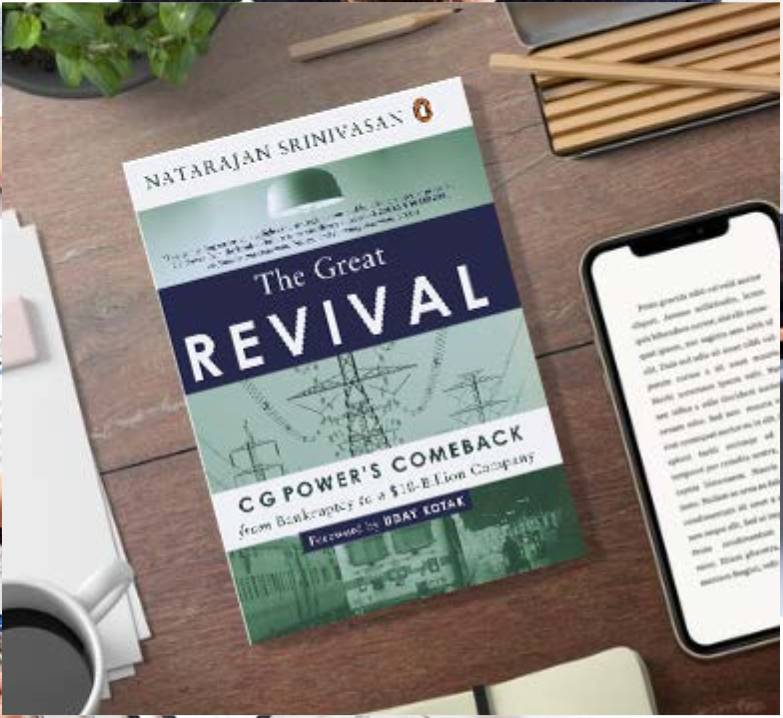

The book ‘The Great Revival’ distils lessons that transcend Balance Sheets and Boardrooms.
The book offers enduring insights for business managers, students, corporate analysts, stockholders – anyone who values integrity in action.
At its core lies the theme of ethical leadership — that transparency in crisis is not weakness but strength.
Second, the book celebrates governance as culture, not compliance. Systems alone cannot prevent collapse; it is people who sustain credibility. The Murugappa Group’s revival of CG Power showcases how a disciplined governance framework can rewire an organisation’s DNA.
The book ‘The Great Revival’ distils lessons that transcend Balance Sheets and Boardrooms.
The book offers enduring insights for business managers, students, corporate analysts, stockholders – anyone who values integrity in action.
At its core lies the theme of ethical leadership — that transparency in crisis is not weakness but strength.
Second, the book celebrates governance as culture, not compliance. Systems alone cannot prevent collapse; it is people who sustain credibility. The Murugappa Group’s revival of CG Power showcases how a disciplined governance framework can rewire an organisation’s DNA.
Third, the book underscores the power of human engagement — how listening, empathy, and visible leadership rebuild morale faster than capital. The mechanics of the turnaround were not imposed from the top; they were co-created by hundreds of stakeholders – employees, customers, vendors and shareholders – who rediscovered pride in their association with the company.
Fourth, the book highlights resilience under scrutiny. The management operated amid investigations, debt pressure, and pandemic disruption — and yet delivered quarter-on-quarter growth through strategic clarity.
Finally, the book reinforces a universal truth: redemption is possible. Whether in business or life, failure is not the endgame; renewal begins when one selects accountability over alibi, and conviction over comfort.
Book extracts
These five passages, drawn directly from the text, collectively trace the moral descent, courageous disclosure, disciplined revival, and triumphant resurgence that make ‘The Great Revival’ a benchmark in corporate storytelling
“Why this story needed to be told”
“CG Power faced serious operational, financial and managerial issues. These crippled day-to-day operations. The existence of a company that had survived eight
“Why this story needed to be told”
“CG Power faced serious operational, financial and managerial issues. These crippled day-to-day operations. The existence of a company that had survived eight decades was threatened… The convergence of these realities was unprecedented in India’s corporate history. …But this was not 30 years ago. This was here and now. This was in a new India where CG Power had failed. Earlier, this failure may have been glossed over; this was now a national embarrassment. The book needed to be written because each time a compromised system is documented, it enhances an awareness of how this can be prevented. It highlights how loopholes were exploited; it provides individuals and teams a deeper understanding of their roles; it helps re- emphasise professional codes; it prevents recurrence.”
“The Board’s self-disclosure”
“On 19 August 2019 – nearly 16 months after the auditor had resigned – the Directors validated the alarm. The Board made a self-disclosure to the National Stock Exchange
“The Board’s self-disclosure”
“On 19 August 2019 – nearly 16 months after the auditor had resigned – the Directors validated the alarm. The Board made a self-disclosure to the National Stock Exchange and Bombay Stock Exchange… The aggregate quantum of unauthorized transactions, the Board said, was estimated at Rs 2,950 crore… This represented an expert manipulation of corporate systems just as it had been a complete vulnerability of modern-day accounting practices. This sent out a message: no company could claim to be completely safe. The Board members had taken their time to be sure. But when they went public, they did so decisively… This was the corporate equivalent of the ship captain picking his sailors and then the hands-on deck staging a mutiny and throwing the captain off the ship.”
“When the new leadership stepped in”
“When Vellayan Subbiah and I assumed charge… our work was cut out. The world was watching. …The new promoter created focused teams (running the business of the day and
“When the new leadership stepped in”
“When Vellayan Subbiah and I assumed charge… our work was cut out. The world was watching. …The new promoter created focused teams (running the business of the day and/or dousing retrospective fires). These teams were provided responsibilities with measurable outcomes… Gradually, the senior management began to use the ‘War Room’ term. This war room was not a room within the company; it was a collection of thematic WhatsApp groups. …Through these small engagements and responses, the seriousness of the new management was validated. The word began to go around: ‘The new management does not just plan; it acts.
“Re-winning trust through repayment”
“To enhance eco-system confidence, the company repaid Rs 700 crore to liquidate the entire dues of operational creditors (suppliers and contractors). This payment was
“Re-winning trust through repayment”
“To enhance eco-system confidence, the company repaid Rs 700 crore to liquidate the entire dues of operational creditors (suppliers and contractors). This payment was made without renegotiation or discount. The employees were paid their outstandings of an aggregate Rs 45 crore in one shot. Once this amount had been credited to hundreds of employee bank accounts, the eco-system began to breathe. There was one thing that all employees began to agree upon: the worst was over. …We owed two things to the vendors: an apology for having delayed their cash flows… and a word of gratitude for their patience. We also emphasised the five words they wanted to hear most: ‘This will never happen again.”
“The resurgence”
“When the Murugappa Group assumed control, only 34 days were left of that third quarter of the financial year 2020-21. Analysts had expected that in the pandemic
“The resurgence”
“When the Murugappa Group assumed control, only 34 days were left of that third quarter of the financial year 2020-21. Analysts had expected that in the pandemic, CG Power would at best report a performance status quo or a decline… The company reported revenues of Rs 703 crore, EBITDA of Rs 92 crore and a profit before tax of Rs 58 crore… Within a week of the fourth-quarter results being announced, the CG Power stock closed at Rs 82 (after Rs 38 on the day before acquisition). …The message: if this is the kind of value the new management could bring to the CG Power table within the first five months, then bigger things were possibly in store.”
Book style and flow
These five passages, drawn directly from the text, collectively trace the moral descent, courageous disclosure, disciplined revival, and triumphant resurgence that make ‘The Great Revival’ a benchmark in corporate storytelling
“Why this story needed to be told”
“CG Power faced serious operational, financial and managerial issues. These crippled day-to-day operations. The existence of a company that had survived eight decades was threatened… The convergence of these realities was unprecedented in India’s corporate history. …But this was not 30 years ago. This was here and now. This was in a new India where CG Power had failed. Earlier, this failure may have been glossed over; this was now a national embarrassment. The book needed to be written because each time a compromised system is documented, it enhances an awareness of how this can be prevented. It highlights how loopholes were exploited; it provides individuals and teams a deeper understanding of their roles; it helps re- emphasise professional codes; it prevents recurrence.”
“Why this story needed to be told”
“CG Power faced serious operational, financial and managerial issues. These crippled day-to-day operations. The existence of a company that had survived eight decades was threatened… The convergence of these realities was unprecedented in India’s corporate history. …But this was not 30 years ago. This was here and now. This was in a new India where CG Power had failed. Earlier, this failure may have been glossed over; this was now a national embarrassment. The book needed to be written because each time a compromised system is documented, it enhances an awareness of how this can be prevented. It highlights how loopholes were exploited; it provides individuals and teams a deeper understanding of their roles; it helps re- emphasise professional codes; it prevents recurrence.”
“Why this story needed to be told”
“CG Power faced serious operational, financial and managerial issues. These crippled day-to-day operations. The existence of a company that had survived eight decades was threatened… The convergence of these realities was unprecedented in India’s corporate history. …But this was not 30 years ago. This was here and now. This was in a new India where CG Power had failed. Earlier, this failure may have been glossed over; this was now a national embarrassment. The book needed to be written because each time a compromised system is documented, it enhances an awareness of how this can be prevented. It highlights how loopholes were exploited; it provides individuals and teams a deeper understanding of their roles; it helps re- emphasise professional codes; it prevents recurrence.”
The flow is cinematic: from the unravelling of fraud to the shock of disclosure, from the arrival of new leadership to the slow, deliberate rebuilding of trust. Each chapter builds tension, resolves it through methodical action, and leaves behind a trail of insight.
What keeps readers engaged is the authenticity — unvarnished facts, behind-the-scenes struggles, and moral choices rendered without melodrama. The narrative’s rhythm mirrors the company’s recovery curve: chaotic at first, steady in the middle, and ultimately luminous — a journey from disorder to disciplined hope.