
Why ‘The Great Revival’
matters for India today
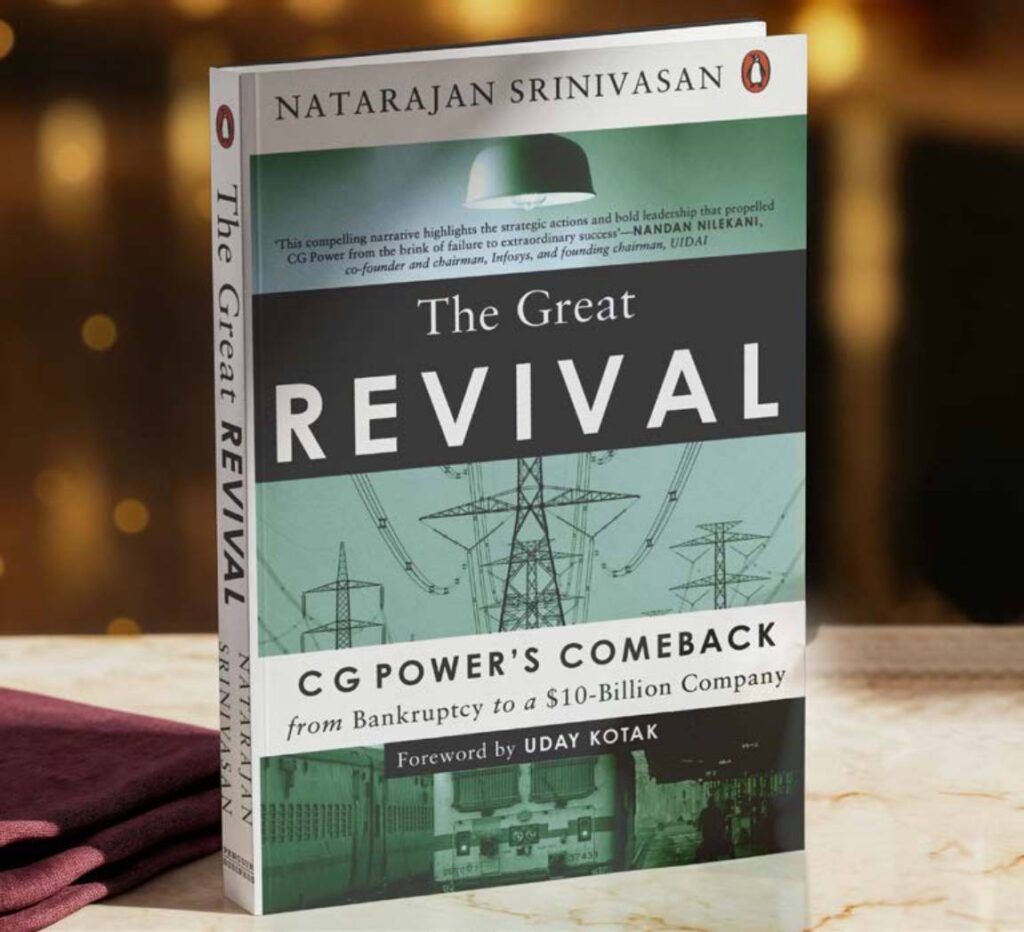
India in 2025 stands at a crossroad between ambition and accountability — aspiring to be the world’s manufacturing workshop, while still haunted by potential corporate lapses that can erode public trust. ‘The Great Revival’ is therefore not merely the story of CG Power’s extraordinary revival; it is a mirror to India’s maturing capitalism.
The book documents how one of India’s oldest engineering giants was gutted by governance failure, then rescued through discipline, transparency and ethical leadership. It redefines what ‘turnaround’ means in an India now ruled by the Companies Act 2013, SEBI vigilance, and RBI’s stressed-asset framework. It proves that revival need not depend on bankruptcy tribunals or political rescue; it can be achieved through competence, credibility and culture.
Why “The Great Revival” matters for India today
India in 2025 stands at a crossroad between ambition and accountability — aspiring to be the world”s manufacturing workshop, while still haunted by potential corporate lapses that can erode public trust. “The Great Revival” is therefore not merely the story of CG Power”s extraordinary revival; it is a mirror to India”s maturing capitalism.
The book documents how one of India”s oldest engineering giants was gutted by governance failure, then rescued through discipline, transparency and ethical leadership. It redefines what “turnaround” means in an India now ruled by the Companies Act 2013, SEBI vigilance, and RBI”s stressed-asset framework. It proves that revival need not depend on bankruptcy tribunals or political rescue; it can be achieved through competence, credibility and culture.
In an era of corporate frauds and public scepticism, this book restores faith that Indian enterprise can self-correct. It shows how an industrial group with unimpeachable integrity — the Murugappas — could rebuild a company once branded as a “fraud account” into a US $10 bn success story.
For policymakers, boards and young professionals alike, “The Great Revival” is a real-world management textbook. It demonstrates that in the India of today, good governance is not an option; it is the only sustainable business model.
Most Indian business books celebrate success; “The Great Revival” dissects failure — and redemption. It is not a management sermon written in hindsight but a ringside chronicle of crisis, recovery, and moral repair. Unlike conventional corporate biographies that glorify founders, this one honours institutional courage — a Board that exposed its own wounds, a new promoter that bet on a “fraud account,” and employees who fought not for bonuses, but for identity.
Equally, the book humanises management. The narrative lives in factory floors, WhatsApp war rooms, and shop-level pride — proving that revival is a collective emotion, not a boardroom diktat. In a genre filled with boardroom wisdom and economic prophecy, “The Great Revival” reads like a thriller with a conscience. It shows that Indian enterprise has matured — not just to win, but to atone, rebuild, and win again. That rare honesty is what gives this book its pulse.
Value-add
Does ‘The Great Revival’ tick all the boxes of an engaging business book?
Unequivocally, yes. The book succeeds because it does not merely recount a turnaround — it narrates, educates, and inspires in equal measure. The book checks every hallmark of an engaging business title.
It has conflict and resolution, the basic architecture of any compelling narrative: a great company brought down by deceit, a rescue led by principle, and a rise engineered through discipline.
Does ‘The Great Revival’ tick all the boxes of an engaging business book?
Unequivocally, yes. The book succeeds because it does not merely recount a turnaround — it narrates, educates, and inspires in equal measure. The book checks every hallmark of an engaging business title.
It has conflict and resolution, the basic architecture of any compelling narrative: a great company brought down by deceit, a rescue led by principle, and a rise engineered through discipline.
It offers authenticity, drawn from first-hand experience rather than retrospective analysis — giving readers an insider’s access to crisis meetings, lender negotiations, and morale rebuilding on the shop floor.
It blends technical learning (corporate governance, RBI frameworks and stakeholder management) with emotional intelligence — showing how transparency, empathy, and trust can be hard management tools. The prose is crisp, chronological, and free of jargon, making complex events readable even to a non-specialist.
Most importantly, the book comprises a moral centre. It restores faith that Indian business can correct itself from within. That combination — drama, detail, discipline, and decency — is what makes ‘The Great Revival’ not just an informative business book, but a deeply human one whose influence extends beyond the last page.
Learnings
There are various learnings from the book
One, governance is not a checklist; it is a culture. CG Power’s collapse was not a Balance-Sheet failure but a values failure. When the moral compass spins, even an 80-year-old institution can lose its North. The book communicates that governance must be lived daily, not declared annually.
Two, leadership is not about arriving with answers, but asking the right questions. Vellayan Subbiah and Natarajan Srinivasan did not swagger in with slogans; they listened, engaged, persuaded, and re-wired belief. When the company’s employees perceived that humility, they signed on emotionally.
Three, revival starts out as a human act before it becomes a financial one. The turnaround was powered by welders, floor supervisors, and accountants who refused to let ‘CG’ be discussed in the past tense. Capital was important; pride was priceless.
Four, India is no longer tolerant of corporate decay. Regulators, investors, and lenders now demand consequence. The CG Power resurrection proves that Indian capitalism has grown a conscience — and that governance can be transformed into a competitive advantage.
For students…
Business schools teach strategy, finance, and marketing — but ‘The Great Revival’ teaches character under pressure. It is a case study in how leadership behaves when the playbook burns.
Students will see that turnarounds are not MS Excel exercises; they are human dramas. When CG Power collapsed under fraud and regulatory siege, the new management focused on rebuilding trust before it rebuilt its Balance Sheet. It led with clarity, not charisma — proving that credibility compounds faster than capital.
The book also underscores the importance of governance literacy. Future managers will learn that internal controls, Board ethics, and audit vigilance are not bureaucratic rituals; they are survival tools in a transparent economy.
Business schools teach strategy, finance, and marketing — but ‘The Great Revival’ teaches character under pressure. It is a case study in how leadership behaves when the playbook burns.
Students will see that turnarounds are not MS Excel exercises; they are human dramas. When CG Power collapsed under fraud and regulatory siege, the new management focused on rebuilding trust before it rebuilt its Balance Sheet. It led with clarity, not charisma — proving that credibility compounds faster than capital.
The book also underscores the importance of governance literacy. Future managers will learn that internal controls, Board ethics, and audit vigilance are not bureaucratic rituals; they are survival tools in a transparent economy.
Equally important, students will discover the power of culture in execution. The Murugappa Group’s Five Lights — Integrity, Passion, Quality, Respect, Responsibility —validate that culture can align 5,000 employees faster than any memo.
Finally, ‘The Great Revival’ demonstrates that India’s new business order rewards moral consistency as much as market performance. It reminds young leaders that revival is not about restoring profit margins; it is about restoring faith. And that — in any Balance Sheet — is the ultimate bottom line.
Turnaround initiatives
The 3 most courageous initiatives behind CG Power’s turnaround
comprise the following:
Public confession before survival
In a corporate world that buries its sins, CG Power’s Board did the opposite — it went public with a self-disclosure of unauthorised transactions amounting to nearly ₹3,000 crore. This was not damage control; it was moral surgery in full daylight.
Paying creditors in full, before profit
When Tube Investments and the Murugappa Group took charge, CG Power was bleeding — classified as a ‘fraud account’, its accounts frozen. Yet, instead of pleading helplessness, the new management paid ₹700 crore to vendors and ₹45 crore to employees almost immediately following the assumption of management control. This act of fairness restored trust faster than any turnaround plan could. It communicated to the ecosystem: We will honour every commitment before we rebuild the company.
Declaring an
‘Unconstrained battle plan’:
At a time when survival would have been considered success, CG Power’s leadership asked business heads to dream again — to build ‘unconstrained business plans.’ No excuses, no half-measures. That audacity — to think scale in the middle of ashes — converted resignation into resurgence. The result: a twenty-fold rise in market capitalisation within three years.
Hidden layers
There are hidden layers in this book.
Beneath its surface as a corporate turnaround story, ‘The Great Revival’ carries quiet but profound layers that reward reflective readers.
At one level, it is a moral fable disguised as a business book — a study of how ethical leadership can outlast financial collapse. The public disclosure of fraud, the humility of new management, and the insistence on cultural renewal reveal that governance is ultimately an act of conscience.
There are hidden layers in this book.
Beneath its surface as a corporate turnaround story, ‘The Great Revival’ carries quiet but profound layers that reward reflective readers.
At one level, it is a moral fable disguised as a business book — a study of how ethical leadership can outlast financial collapse. The public disclosure of fraud, the humility of new management, and the insistence on cultural renewal reveal that governance is ultimately an act of conscience.
A subtler layer is its portrait of modern Indian capitalism: where regulatory vigilance, institutional accountability, and investor scrutiny converge to make redemption possible without political intervention. The book captures the shift from a forgiving, relationship-based business culture to one anchored in systems, transparency, and professional integrity.
There is also a human layer — the unspoken dignity of stakeholders who chose pride over despair. Their quiet determination to ‘improve the corner’ embodies a work ethic that business schools rarely teach but every leader must learn.
Finally, the book hides a philosophy of leadership by example: responding to crisis not with speeches but with action. Read closely, ‘The Great Revival’ is not about a company’s revival alone — it is about how character rebuilds credibility, one decision at a time.